

Should I go to Palatine Hill or Colosseum first? Best order, tips, and itinerary
- 7 min read
At first, planning a visit to Rome often raises a practical but crucial question: Palatine Hill or Colosseum first? Because these iconic sites are part of the same archaeological area, the order of visit directly affects time management, crowd control, and the overall understanding of ancient Rome. As a result, choosing the right sequence helps tourists enjoy a smoother, more meaningful, and less stressful experience.
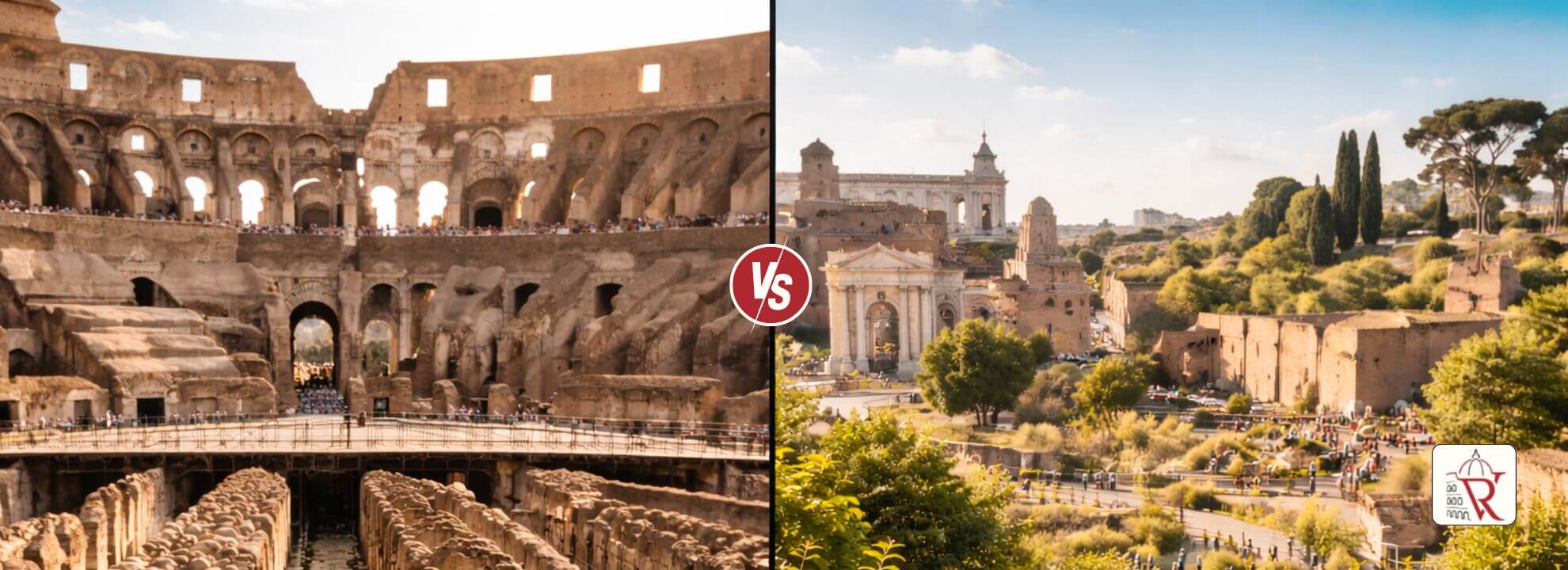
Which one should you visit first: Colosseum or Palatine Hill?
Short answer: start with the Colosseum, then continue to the Roman Forum and finish on Palatine Hill.
Although this may be true for most travelers, the reasons are quite concrete:
- Crowd management: the Colosseum attracts the largest crowds, so it is better tackled first.
- Emotional impact: entering Rome through its most powerful symbol sets the tone.
- Historical flow: the story moves logically from spectacles to daily life to imperial power.
- Security checks: Colosseum controls are stricter and more time-consuming.
⚠️ This sequence is crucial for featured snippets and practical planning, because it reflects how the site is designed to be experienced.
In short, when asking Palatine Hill or Colosseum first, the most efficient answer points clearly in one direction.
Why starting with the Colosseum makes sense
The Colosseum sets the context
Certainly, the Colosseum is more than a monument. It is the symbol of Rome itself. As has been noted by countless historians, gladiatorial games, imperial propaganda, and mass entertainment all converged here. Because of this, starting inside the arena helps visitors “read” everything that comes afterward.
Analogous to opening a book from its first chapter, beginning with the Colosseum provides narrative grounding. The grandeur and social dynamics of ancient Rome become immediately tangible. As a result, when one later walks through ruins, columns, and foundations, those stones already carry meaning.
Another key point is orientation. From the Colosseum, the transition into the Forum feels natural and chronological, rather than fragmented or confusing.
Crowd control and time management
Another reason to answer Palatine Hill or Colosseum first with confidence lies in crowd dynamics. Comparatively, the Colosseum has longer queues, stricter entry times, and heavier security procedures.
Because energy levels are higher earlier in the day, it makes sense to face the busiest site first. Conversely, starting with Palatine Hill may lead to fatigue before reaching the Colosseum, especially during peak season. As can be seen every morning, visitors who reverse the order often arrive tired and rushed.
Palatine Hill, by contrast, is calmer, greener, and more spacious. Consequently, it works better as a closing chapter rather than an opening challenge.
Colosseum, Roman Forum and Palatine Hill Guided Tour + ancient Rome tour
What happens if you start from Palatine Hill instead?
The views are stunning, and the atmosphere is peaceful. However, without the Colosseum’s context, those ruins can feel abstract.
Another issue arises with timing. As soon as Palatine Hill is explored first, there is a risk of reaching the Colosseum later in the day, when lines are longer and crowds denser. Doubtfully, this improves the experience.
Additionally, the narrative becomes fragmented. Instead of moving from spectacle to politics to power, the story jumps ahead and then backtracks. That is why most experts — and guided itineraries — follow the opposite route.
Altogether, while it is possible to reverse the visit, it is rarely optimal when considering Palatine Hill or Colosseum first.
The best route to visit Colosseum, Roman Forum and Palatine Hill
💡 The ideal itinerary follows a simple but effective flow:
- Colosseum – ideally with priority access
- Roman Forum – along the Via Sacra, past the Arch of Titus
- Palatine Hill – imperial palaces and panoramic viewpoints
This is the exact flow used in the most efficient guided tours. Designed to avoid backtracking and wasted time, it allows the story of Rome to unfold step by step.
Correspondingly, the visitor moves from public spectacle to civic life, and finally to the private world of emperors. As a result, the ruins stop being isolated remains and become part of a coherent narrative.
Colosseum, Roman Forum and Palatine Hill Guided Tour + ancient Rome tour
Is a guided tour worth it for Colosseum, Roman Forum and Palatine Hill?
Why these sites are better with a guide
Although many travelers attempt a self-guided visit, the complexity of these ruins should not be underestimated. The Roman Forum, in particular, is a dense archaeological puzzle. Without explanation, temples, basilicas, and arches blur together.
A guide transforms stones into stories. As has been shown repeatedly, details about politics, religion, and daily life are easily missed otherwise. Because of this, guided tours offer clarity rather than information overload.
Priority access makes the difference
Another key point is time. Guided tours often include priority access, which avoids long queues at the Colosseum. Consequently, more time is spent inside the sites and less time waiting outside.
At any rate, for travelers with limited days in Rome, this advantage alone can justify the choice.
Semi-private guided tours: the smart compromise
If efficiency and depth are both priorities, semi-private guided tours represent a balanced solution. Instead of large crowds, small groups ensure a more human pace. As well as that, guides are often top-rated specialists.
If you want the efficiency of a well-planned itinerary without the feeling of being rushed, a semi-private guided tour is often the best option.
Such tours typically include priority access to the Colosseum, Roman Forum, and Palatine Hill. Consequently, the recurring question Palatine Hill or Colosseum first becomes irrelevant — the route is already optimized.
Colosseum, Roman Forum and Palatine Hill Guided Tour + ancient Rome tour
Final thoughts on Palatine Hill or Colosseum first
Altogether, the debate around Palatine Hill or Colosseum first has a clear answer for most travelers. Starting with the Colosseum creates a stronger narrative, better crowd management, and a more satisfying flow. Although alternative routes exist, they often introduce unnecessary friction.
By following the historical and logistical logic of the site, the experience becomes not only smoother but also more memorable.
FAQ about Palatine Hill or Colosseum first
Can I visit Palatine Hill before the Colosseum?
Yes, it is possible, but as has been noted, it is not the most efficient or immersive order.
Did Rome start on Palatine Hill?
Yes. As a matter of fact, tradition holds that Rome was founded on Palatine Hill, making it historically significant.
How much time do you need at Palatine Hill?
Generally, 1 to 1.5 hours is sufficient, although this may vary depending on interest.
Is 2 hours enough for the Colosseum?
Yes, for the main levels. However, additional areas require more time.
Is it worth visiting Palatine Hill?
Certainly. Besides its history, it offers some of the best views in Rome.
Is it better to see the Colosseum in the morning or afternoon?
Early morning visits are preferable because crowds are lighter and temperatures cooler.
Is there a dress code for the Colosseum?
No strict dress code applies, but comfortable clothing and shoes are recommended. For more information check the article Colosseum Dress Code: What to Wear, What Not to Bring, and Practical Tips
How early should I arrive at the Colosseum?
At least 15–30 minutes before the scheduled entry time.
Is it worth paying to go into the Colosseum?
Yes. The interior provides essential context that cannot be gained from outside alone.
Do I need a passport for the Colosseum?
All Colosseum tours require photo ID for all participants; plan to bring your passports on the day of your tour. Failure to show identification will result in the denial of entry to the site.