

What not to miss in Borghese Gallery? Top artworks, tips and best tour
- 8 min read
When planning a trip to Rome, understanding what not to miss in Borghese Gallery helps you appreciate one of the city’s most intimate and breathtaking art collections. Although the museum is small, it holds masterpieces by Bernini, Caravaggio, Raphael, and Canova that are essential to any cultural itinerary. Consequently, knowing what not to miss in Borghese Gallery allows tourists to move confidently through its rooms, enjoy the unique atmosphere, and experience some of the most extraordinary artworks in Europe without feeling overwhelmed.

Borghese Gallery small group Guided Tour
History of Borghese Gallery
The Borghese Gallery began as the private villa and personal art collection of the influential Borghese family, chiefly enriched during the 17th century under Cardinal Scipione Borghese. Although the estate originally showcased the family’s political and cultural prestige, it later became one of Rome’s most celebrated public museums. As a result, today’s visitors step not only into an art gallery but into a preserved chapter of Italian aristocratic history.
Inside the Borghese Gallery, travellers encounter an extraordinary mix of sculptures, paintings, mosaics and decorative frescoes. Although the museum is compact, it holds works that shaped the evolution of European art — from Bernini’s dynamic Baroque sculptures to Caravaggio’s revolutionary use of light, and from Renaissance elegance to neoclassical refinement. Because of this diversity, understanding what is not to miss in Borghese Gallery ensures a smoother, more meaningful visit.
The article organizes the artworks into clear categories, allowing visitors to follow a thematic and intuitive path:
- Sculptures (Bernini masterworks, Canova classics, mythological groups)
- Paintings (Caravaggio highlights, Renaissance masterpieces, mythological scenes)
- Decorated galleries & thematic rooms (Apollo & Daphne Room, Gladiator Room, Paolina Borghese Room)
- Ceilings and fresco cycles (mythological frescoes, allegorical decorations, Baroque ceiling programs)
- Ancient works & entrance hall details (Roman reliefs, mosaics, myth-inspired carvings)
This breakdown helps visitors understand how the gallery’s contents are arranged and what categories define the essential experiences not to miss in Borghese Gallery.
Borghese Gallery small group Guided Tour
1. Sculptures not to miss in Borghese Gallery
Apollo and Daphne – Bernini (Barocco, 1622-1625)
Although the sculpture is carved entirely from marble, the scene appears weightless: Apollo reaches forward as Daphne transforms into a laurel tree. As soon as the visitor walks around the piece, the shift from human to bark becomes visible, creating one of the most emotional moments not to miss in Borghese Gallery. As a matter of fact, the masterful illusion of movement is what made Bernini famous at the age of just twenty-four.
The Rape of Proserpina – Bernini (Barocco, 1621-1622)
As can be seen from Pluto’s fingers pressing deeply into Proserpina’s thigh, Bernini treated marble as if it were warm flesh. Consequently, the drama of the abduction emerges through gestures and expressions rather than symbolism alone. Although this may be true, visitors often focus on the emotional tension between the figures, making this another masterpiece not to miss in Borghese Gallery.
David – Bernini (Barocco, 1623-1624)
Unlike Michelangelo’s calm hero, Bernini’s David twists his body mid-action. At any rate, every muscle shows anticipation. As shown above in Bernini’s other works, the Baroque aimed to freeze dramatic motion, and this sculpture perfectly represents that intention. It is correspondingly one of the sculptures not to miss in Borghese Gallery.
Aeneas, Anchises and Ascanius – Bernini (Barocco, 1618-1619)
This mythological group illustrates three generations of the Trojan family fleeing the burning city. Another key point is how each figure symbolizes a stage of life: youth, maturity, and old age. As an illustration, Bernini uses weight, posture, and facial expressions to narrate loyalty and duty. This early work is an essential chapter in understanding Bernini’s evolution and is not to miss in Borghese Gallery.
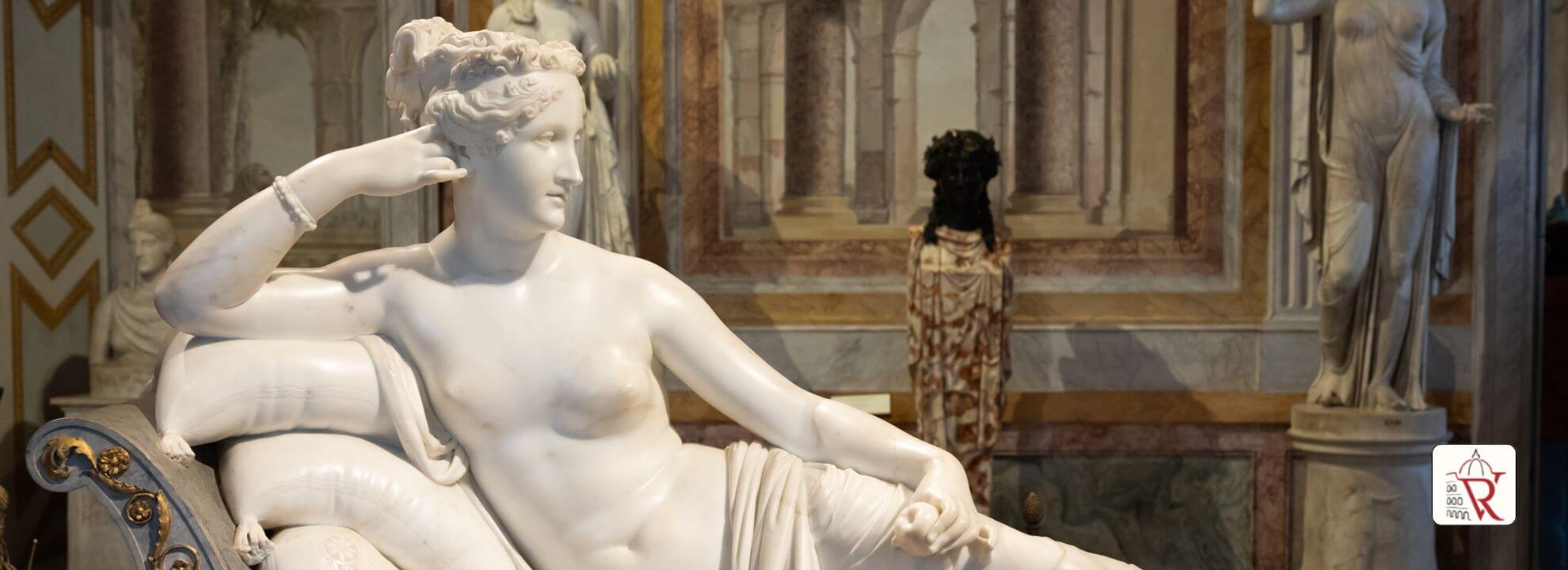
Paolina Borghese as Venus Victrix – Canova (Neoclassicismo, 1805-1808)
Contrarily to Bernini’s emotional dynamism, Canova offers serene perfection. Paolina reclines as Venus, holding an apple like the goddess of beauty. As a matter of fact, the highly polished marble creates the illusion of soft skin illuminated by candlelight. Because this sculpture embodies neoclassical ideals of harmony and refinement, it is undoubtedly not to miss in Borghese Gallery.
2. Paintings not to miss in Borghese Gallery
Boy with a Basket of Fruit – Caravaggio (Barocco, 1593-1594)
As long as visitors study the fruit and shadows, they notice Caravaggio’s meticulous realism. Although this may be true, the portrait also carries a quiet intimacy. Because it marks one of Caravaggio’s earliest breakthroughs, it is absolutely not to miss in Borghese Gallery.
David with the Head of Goliath – Caravaggio (Barocco, 1609-1610)
Comparatively darker than most Renaissance works, this painting confronts the viewer with victory and remorse. As I have said, Caravaggio’s chiaroscuro amplifies internal turmoil. At any rate, the belief that Goliath’s severed head may be Caravaggio’s self-portrait adds psychological depth, making it one of the most haunting pieces in the museum.
Sick Bacchus – Caravaggio (Barocco, 1593-1594)
Despite its mythological subject, Bacchus appears ill, pale, and drained. Contrarily to traditional depictions of the wine god, this version exposes human fragility. Consequently, the painting feels unsettling, yet it is certainly not to miss in Borghese Gallery.
The Deposition – Raphael (Rinascimento, 1507)
As has been noted by scholars, Raphael perfected emotional harmony. The figures carry the body of Christ with grief expressed through soft lines and balanced composition. Because of its serene gravity, the painting stands out among the gallery’s Renaissance treasures.
Sacred and Profane Love – Tiziano (Rinascimento, 1514)
As soon as the viewer examines both female figures, symbolic contrasts emerge: sensuality versus purity, earthly beauty versus divine grace. Although interpretations vary, the mystery surrounding the scene is what has made the painting timeless. Undoubtedly, it is not to miss in Borghese Gallery.
Borghese Gallery small group Guided Tour
3. Galleries and rooms worth noting in Borghese Gallery
- The Apollo and Daphne Room – Bernini: Although the sculpture dominates the space, the surrounding frescoes narrate related myths, creating a coherent environment. As soon as visitors enter, the room prepares them emotionally for transformation and pursuit — themes central to the sculpture itself.
- The Gladiator Room: As a matter of fact, this room emphasizes strength and movement, echoing ancient Roman ideals. Comparatively more dramatic, its ceiling depicts heroic scenes that interact visually with the statues below.
- The Paolina Borghese Room: As can be seen, the neoclassical palette of the room enhances the sculpture’s purity. Despite its simplicity, the ambience feels regal and intimate, making this room not to miss in Borghese Gallery.
4. Ceilings and frescoes in Borghese Gallery
- Mythological ceiling frescoes: As long as visitors lift their gaze, scenes of gods, heroes, and allegories appear in vivid motion. Because these frescoes mirror the themes on the walls and floors, they create a multi-layered storytelling environment.
- Allegorical cycles: Despite being “background” decorations, these cycles provide symbolic meaning to the rooms. Conversely to the sculptures’ realism, these frescoes lean toward abstraction and philosophy. Consequently, they enrich the entire visit.
5. Minor works and details that enrich the visit
- Ancient mosaics: The entrance hall features Roman mosaics depicting gladiators and mythological creatures. As can be seen from their intricacy, these works balance the more dramatic sculptures with archaeological charm. Consequently, even these “minor” pieces deepen the visitor’s understanding of Roman visual culture.
- Roman reliefs: Before stepping into the main galleries, guests encounter reliefs celebrating myth and civic identity. Despite their smaller size, they introduce themes explored throughout the museum. Understanding these early works enhances appreciation of what is not to miss in Borghese Gallery by framing the entire experience.
Borghese Gallery small group Guided Tour
FAQ – about what not to miss in Borghese Gallery
What to see in Villa Borghese?
Villa Borghese refers to the larger park and estate surrounding the gallery. While the grounds and gardens are free to access and lovely to stroll, the art collection — with its masterpieces by Bernini, Caravaggio, Raphael and more — resides in the Borghese Gallery museum. The gallery is what most people mean when they ask what to see in Villa Borghese.
How long should you spend at Borghese Gallery?
Typically a visit lasts two hours — because entry is organized in two-hour slots. That said, with careful planning and focus on key works, that time is enough to see the highlights (and what should not be missed in Borghese Gallery).
Is there a dress code for the Borghese Gallery?
There is no formal dress code like for religious sites. However, since visitors will move through elegant rooms and encounter delicate artworks, it is best to dress respectfully and comfortably.
Can you bring water into the Borghese Gallery?
Policies may vary — yet as a matter of precaution many historic museums ask visitors to avoid open bottles near artworks. It is advisable to drink water before or after the visit, or use a closed bottle if allowed.
Are backpacks allowed in Borghese Gallery?
Large bags and backpacks are generally not allowed — visitors must deposit them at the cloakroom at the entrance.
Is it okay to drink tap water in Rome?
Yes — tap water in Rome is normally safe to drink. Many fountains (“nasoni”) provide fresh potable water throughout the city.
Do I need a passport for Borghese Gallery?
A passport per se is not needed — a valid ID is sufficient. The main requirement is a booked ticket for the correct time slot.